
AgentOps
AI Gateway in practice: control models, access, and usage
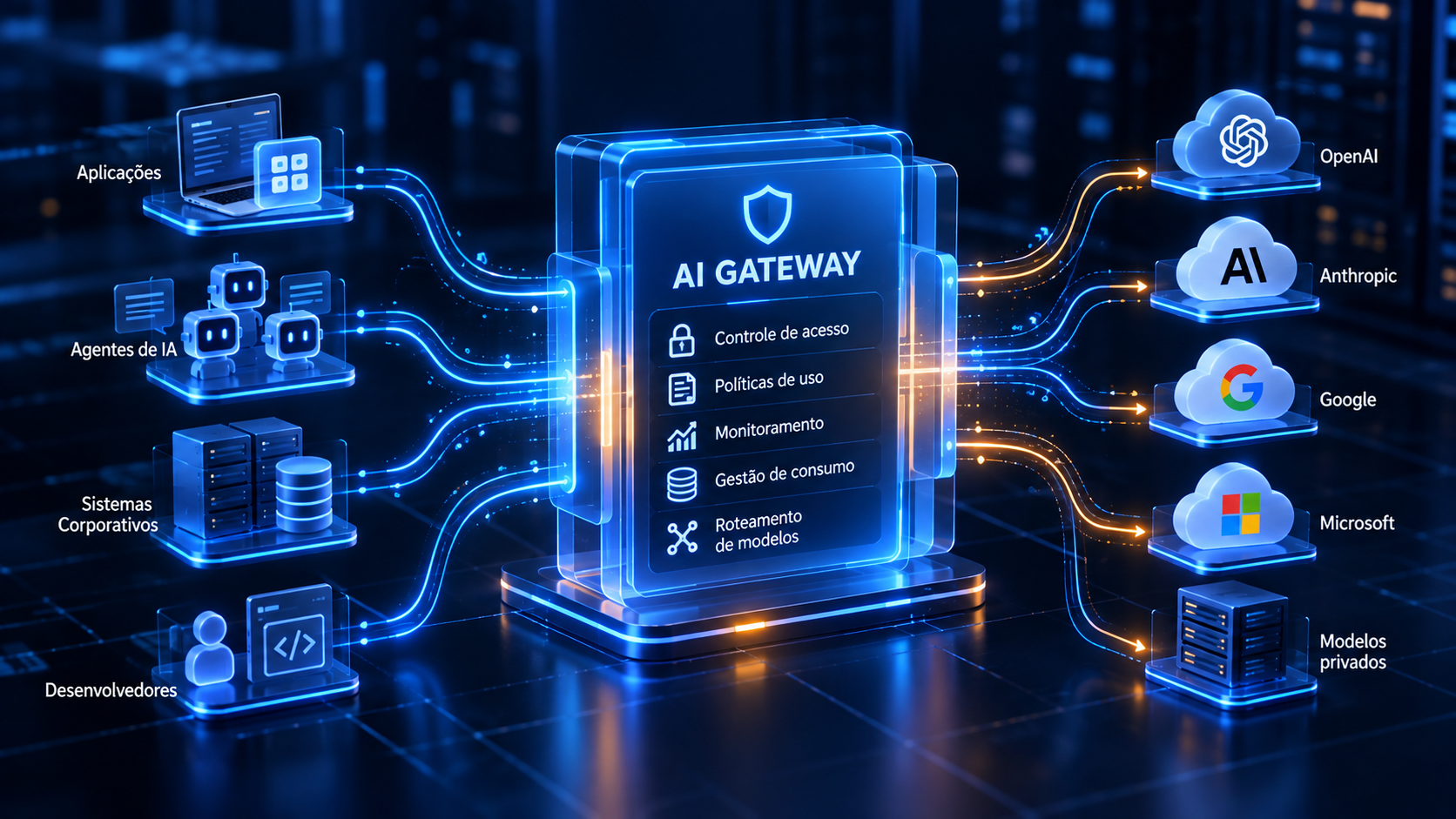
A company uses artificial intelligence in customer service, document analysis, and the automation of internal processes. Each application may access different models, with their own vendors, credentials, prices, and limits.
While these initiatives are isolated, consumption can be tracked individually. The problem appears when dozens of applications and agents start using different AI services, without a common view of access, policies, and resource usage.
This scenario is already part of the reality of many organizations. According to Datadog’s State of AI Engineering 2026 report, 69% of the organizations analyzed used three or more artificial intelligence models in their environments [1].
The survey was based on data from Datadog customers with AI applications in production. It therefore does not necessarily represent the reality of every company, but it shows the diversification of models in the environments analyzed.
As this diversity increases, an important question arises: how do you control who uses the models, which policies must be respected, and how much each application or agent is consuming?
This is the context in which the AI Gateway, or artificial intelligence gateway, gains relevance: a layer that lets you mediate and control the interactions among applications, agents, and AI services.
What an AI Gateway is and how it works
An AI Gateway works as an intermediation point between the applications that use artificial intelligence and the models or services responsible for processing the requests.
Instead of each application establishing independent connections with different providers, the gateway can offer a common layer to organize access, route requests, and enforce usage policies.
IBM defines an AI Gateway as a specialized platform that connects applications and AI models, allowing governance, security, routing, and operational tracking mechanisms to be centralized [2].
Consider a company that uses different models to interpret documents, answer questions, and analyze information. Without a common layer, each application may need to manage its own credentials, limits, and monitoring mechanisms.
With an AI Gateway, part of these controls can be organized in a shared way, while still using the models best suited to each need.
This approach also makes it easier to track requests routed to different providers and, depending on the solution adopted, makes it possible to establish criteria for selecting models according to cost, performance, or availability requirements.
The main benefit is not concentrating all models with a single vendor, but creating the conditions to use them with consistent policies and controls.
Microsoft’s documentation for Azure API Management confirms this approach, including features for authentication, authorization, traffic management, consumption limits, and observability of interactions with AI services [3].
However, the available features vary according to the product and its configuration. Not every AI Gateway offers the same level of control or integration.
How to control access, policies, and AI usage
One of the main difficulties in corporate use of AI is making sure different applications respect the policies established by the organization.
Imagine that a company makes AI models available to customer service agents, development teams, and administrative applications.
Each group has different needs. Certain applications may use more advanced models, while others run simple tasks that do not justify the same level of processing and cost.
There may also be restrictions related to the data used, the volume of requests, or the conditions for accessing the services.
An AI Gateway can help manage these differences through policies applied to the calls that pass through it.
Microsoft documents, for example, mechanisms to set token consumption limits per application or consumer, preventing a single application from using all the available capacity and harming other activities [3].
This capability is especially important when different areas share AI resources.
Controlling consumption does not just mean finding out how much was spent at the end of the month. It also means setting limits and tracking usage during operation.
Google Cloud Apigee’s documentation presents similar capabilities, including security policies, token limits, and routing of requests between models according to usage rules [4].
These mechanisms help organize three important aspects of the operation: who can access certain services, which conditions must be respected, and how consumption evolves over time.
In addition, tracking requests can provide information on volumes processed, response times, token usage, and possible failures.
This visibility makes it possible to identify changes in the usage pattern and support decisions on capacity, costs, and efficiency.
However, there is an important distinction. Limiting tokens or requests is not necessarily the same as controlling all the costs of an AI application.
A process may involve different models, tools, external services, and multiple execution steps. That is why gateway controls need to be complemented by a broader view of operational costs, including agent identity and access and the real cost beyond tokens, especially when the company uses autonomous agents.
Why AI Gateway and AgentOps are complementary
The AI Gateway helps control access to artificial intelligence models and services. However, how an agent works involves activities that can go beyond these interactions.
A customer service agent, for example, may query a language model to interpret a request, access the customer record, check financial information, and execute an action in a corporate system.
The gateway can track and control the calls to models that pass through it. But that does not necessarily mean it can understand or govern all the decisions and actions the agent takes during the process.
This difference helps explain the relationship between AI Gateway and AgentOps, an approach focused on the orchestration, monitoring, observability, and governance of AI agents in operation.
IBM also distinguishes the AI Gateway from the AI Agent Gateway, a layer focused on the agents’ broader interactions with tools, systems, and other agents [5].
This distinction is useful to understand the responsibilities involved, although functionality may overlap in the solutions available in the market.
For a company, the challenge does not end at controlling access to models. It is necessary to track the behavior of agents, their interactions with corporate systems, the tasks executed, and the resources consumed.
The AI Gateway helps control how AI resources are accessed and used, while AgentOps extends that view to the operation of agents and the processes they take part in.
The two capabilities complement each other, especially in environments where different teams use multiple models, applications, and platforms.
This combination helps prevent the growth of AI usage from happening in a fragmented way, with different controls in each application and little visibility into the operation.
The goal is not to replace existing tools, but to establish mechanisms that let you use different technologies with greater consistency, traceability, and governance.
From vision to practice: ARGUS
As companies expand their use of artificial intelligence models and agents, it becomes important to track not only the consumption of services, but also how those resources are used in corporate processes.
ARGUS, the Operational and Agentic Intelligence platform from Target Solutions, combines AgentOps and AI Gateway capabilities to support this need.
Through AgentOps, the platform contributes to the orchestration, monitoring, observability, and governance of AI agents, offering visibility into their activity and their interactions with the corporate operation.
The AI Gateway layer complements this proposal by supporting the enforcement of access and usage policies for artificial intelligence resources.
ARGUS also lets you track token consumption and the costs associated with each agent individually, helping identify usage patterns and support control and optimization decisions.
By connecting agents, people, and tools in a shared operational context, the platform helps organizations expand their use of AI without losing visibility into their operation.
Learn about ARGUS and see how it works in practice.
About the author
Paulo Florêncio de Menezes is an entrepreneur, partner, and co-founder of companies such as Target Solutions, BiPTT, and ARGUS.
He holds a degree in Data Processing from the Federal University of Amazonas (UFAM), an MBA in Business Management from Fundação Dom Cabral (FDC), and a Professional Master’s in Economics from Fundação Getulio Vargas (FGV).
In his Master’s research, he developed the IBEOP-IA (Brazilian Index of Potential Occupational Exposure to Artificial Intelligence), investigating the potential exposure of Brazilian occupations to AI capabilities by combining occupational data, artificial intelligence patents, and natural language processing techniques.
References
[1] Datadog. State of AI Engineering 2026. Apr. 21, 2026. Report on model usage, AI applications in production, and operational complexity.
[2] IBM. What is an AI gateway? IBM Think. Definition, operation, and main capabilities of AI Gateways.
[3] Microsoft. AI Gateway Capabilities in Azure API Management. Microsoft Learn. Documentation on authentication, policies, token limits, and observability.
[4] Google Cloud. AI Gateway Capabilities. Apigee Documentation. Documentation on AI traffic governance, usage policies, and model routing.
[5] IBM. What Is an Agent Gateway? IBM Think. Jul. 29, 2026. Discussion of the differences between API Gateway, AI Gateway, and AI Agent Gateway.